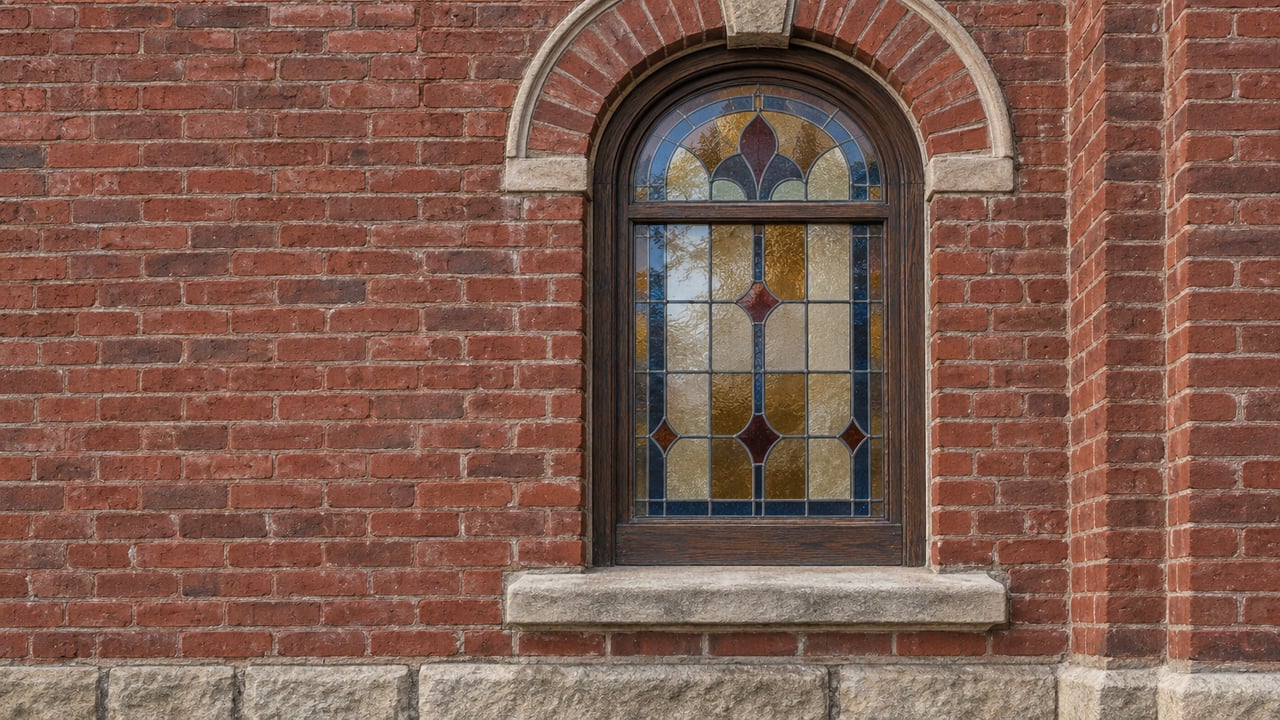
If you are buying a 1920s house in Wesley Heights and plan to replace its original windows, that project will still go before the full Charlotte Historic District Commission after the city's rules are rewritten this fall. That is true even though the most-discussed change in the rewrite is a window rule. The proposal moves original window, front door, and garage door replacement to staff-level administrative review, but only for 1950s, 1960s, and 1970s-era historic buildings.
Wesley Heights became a Local Historic District in 1994. The city describes it as a 1920s streetcar suburb of bungalow-style houses under tree-canopied streets. So the change is being written around a different kind of neighborhood. For a buyer here, a renovation's price depends less on the contractor's bid and more on the review path each line of the bid lands in.
The window rule was written for McCrorey Heights and Oaklawn Park
The window proposal grew out of a survey of McCrorey Heights and Oaklawn Park. Staff found original windows on 44 percent and 45 percent of the historic houses there. Under the proposal, replacements on front elevations would be wood. Side and rear elevations, even those facing a side street, could use steel, aluminum, fiberglass, or wood. Vinyl stays excluded. The Charlotte Historic District Commission's proposal summary then sets out what stays the same:
"Does not include Bungalows or other pre-1949 buildings"
That leaves a Wesley Heights Craftsman under the current standards. Those standards refer original window replacement to the Commission, and favor repair over replacement. They also ask owners to contact staff before ordering or removing windows. Commission applications are due the first Wednesday for the following month's meeting, and the Commission meets on the second Wednesday of each month at 1 p.m. The city currently reports a wait of a few months for full-Commission cases. The Unified Development Ordinance sets a maximum of 180 days for the Commission to act on a properly filed application.
If drafty original sashes are part of your plan, put the Commission calendar into your move-in timeline before you make an offer.
The parts of the rewrite that do apply here
The window relief skips Wesley Heights, but much of the rest of the proposal applies to every district. Several items affect exactly the finishes a new owner tends to change first:
- Masonry. Unpainted masonry would have to stay "unaltered from its original condition," and the text names paint, stain, limewash, and whitewash. Stain would be allowed only to blend poor earlier repair work into the original brick and mortar, with approval required before any work starts.
- Color. Window, door, and roof trim should contrast with the body of the house. "A monochrome palette with all building elements the same color is not appropriate."
- Driveways. Asphalt would not be allowed for sidewalks, curb cuts, driveways, and aprons "in front of the rear thermal wall" of residential-form buildings. The illustration would be updated to show a carriage-strip driveway.
- Front yards. Large rocks and boulders join the list of modern landscape materials not allowed in front yards.
- Dormers. A dormer added to an existing building must be visibly inset, not flush with the wall below it.
- Walkways. Original historic walkways should be kept whenever possible. A replacement in a new material should match the original dimensions.
The color item stands out. Charlotte's current design standards say they do not regulate paint colors. The proposal still would not dictate a palette, but it would rule out the all-one-color exterior. Painting previously unpainted brick is already a major-review item, and the new language spells out that limewash and whitewash count too.
Some changes loosen things. An addition that is neither wider nor taller than the main house, adds less than 50 percent of its square footage, and/or is not substantially visible from the street would go to staff review. So would a garage or accessory dwelling unit that is not substantially visible from the street and is clearly secondary to the main house. The proposal also states that covered porches count toward the 50 percent addition threshold. For a buyer looking at a deep rear yard, a screened backyard cottage could become a staff-level project rather than a Commission hearing.
All of this is still a proposal. Charlotte's Historic District page lists the hearing for Wednesday, October 14, at 12:30 p.m. in Room 280 of the Charlotte-Mecklenburg Government Center. The published timeline calls for a Commission vote on November 12, with the standards taking effect November 13. Until then, the standards adopted in December 2021 and edited in October 2022 still govern.
What each review path costs, as of July 2026
The review path sets the timeline, and since July 1, 2026, it also sets the fee. The city's FY27 fee schedule took effect that day:
| Review type | FY27 fee | Typical examples on the city's schedule |
|---|---|---|
| Administrative review | No fee | Staff-level items |
| Administrative review, after the fact | $1,195 | Same work, done without pre-approval |
| Minor review | $685 | Corner-lot additions under 50%, visible one-story accessory structures |
| Minor review, after the fact | $1,195 | Same work, done without pre-approval |
| Major review, residential up to 4 units | $1,500 | Original window replacement, painting unpainted masonry, additions of 50% or more |
| Major review, multi-family over 4 units | $10,000 | New construction, major additions, original window replacement |
| Demolition, residential up to 4 units | $2,250 | Removing a residential building |
The top row tells you the most. A project that qualifies for staff review costs nothing when it is approved in advance and $1,195 when it is reviewed after the fact. The city's previously posted schedule listed $525 for after-the-fact administrative review. Fees aren't the only consequence. Under the UDO, the city can issue a notice requiring correction or a civil penalty. The owner then has 30 days to correct or appeal, and each day the violation continues can count as a separate offense. For a buyer, this means unpermitted exterior work done by the previous owner is worth asking about during due diligence.
Demolition follows its own rule. It requires a Certificate of Appropriateness and can be delayed up to 365 days if the Commission finds the building significant, but the application cannot be denied.
Recent Wesley Heights cases
Wesley Heights cases appear on the Commission's agenda regularly. On April 9, 2025, the Commission approved, with conditions, window and door changes to an accessory building at 800 Woodruff Place. An accessory dwelling unit at 220 S. Summit Avenue first appeared on the February 2025 agenda as a new case, and it was later continued from the March meeting into April. On May 13, 2026, a solar panel case at 805 Walnut Avenue was listed as a consent item. Staff recommended approval with conditions under the standard that puts panels in less visible roof locations without altering the roof structure.
Solar is a useful example. The standards don't ban it. They set rules for where it can go, and the house's roof orientation decides how easily it fits.
Where the overlay stops
The Commission has no jurisdiction over interior spaces unless the interior layout directly affects the exterior. For most houses, that leaves kitchens, baths, and floor plans outside the Commission's review.
Use is governed separately. The historic overlay covers exterior compatibility, and the underlying zoning district controls use. Charlotte's Unified Development Ordinance says N1-A through N1-E districts allow single-family homes, duplexes, and triplexes. Duplexes and triplexes are allowed subject to prescribed conditions, which is not the same as automatic approval. Zoning varies by parcel, so check the address you are considering on the city's zoning map.
The same overlay covers the neighborhood's larger buildings. 201 Grandin Road appears in the National Register inventory as the c. 1928 Wesley Heights Methodist Episcopal Church, and it went through Commission review in 2020 as a Wesley Heights case. The FY27 schedule charges $10,000 for major review of buildings with more than four units, and its examples include replacing original windows. If you are buying a condo in a converted historic building, ask how the association plans for exterior work, since major exterior changes there fall into that fee category.
FAQ
Will the seller tell me the house is in a historic district? North Carolina's disclosure form has no standalone historic-district question. It asks about violations of zoning or other land-use restrictions and allows a "No Representation" answer. The city publishes a parcel-level boundary map for Wesley Heights. Confirm the property's status with that map and with your own attorney.
What can I do without any review? Ordinary repair and maintenance that doesn't change materials or design is generally not reviewed under Charlotte's design standards. They give re-roofing with in-kind materials as one example, though staff decides what counts as true maintenance. The landscape standards cover major elements and do not apply to minor features such as planting shrubs or flower beds.
Does a building permit cover me? No. Charlotte's historic-district guidance explains that a Certificate of Appropriateness may be required even when no building permit is, and HDC approval doesn't establish zoning entitlement or building-code compliance.
Our team at The Arches Charlotte works inside the Wesley Heights historic district every day, and 201 Grandin Road went through the same review process. If you want help understanding how a particular house or residence fits into these rules before you make an offer, connect with our team.
This article is general information, not legal, tax or financial advice. Consult a qualified professional about your situation.